
Iberville Parish Court Records After Arrest
The local path is arrest, booking at Iberville Parish Jail, bond or first appearance, referral to prosecution, formal charge decision by the 18th Judicial District Attorney, and case maintenance by the Iberville Parish Clerk of Court. The Clerk's Criminal Records Department says it maintains all criminal proceedings of District Court, assists judges by preparing criminal-court documents, and records proceedings of criminal cases initiated by law enforcement and prosecuted by the District Attorney's Office.
The 18th Judicial District Court site is the court-system source for Iberville, West Baton Rouge, and Pointe Coupee criminal matters.
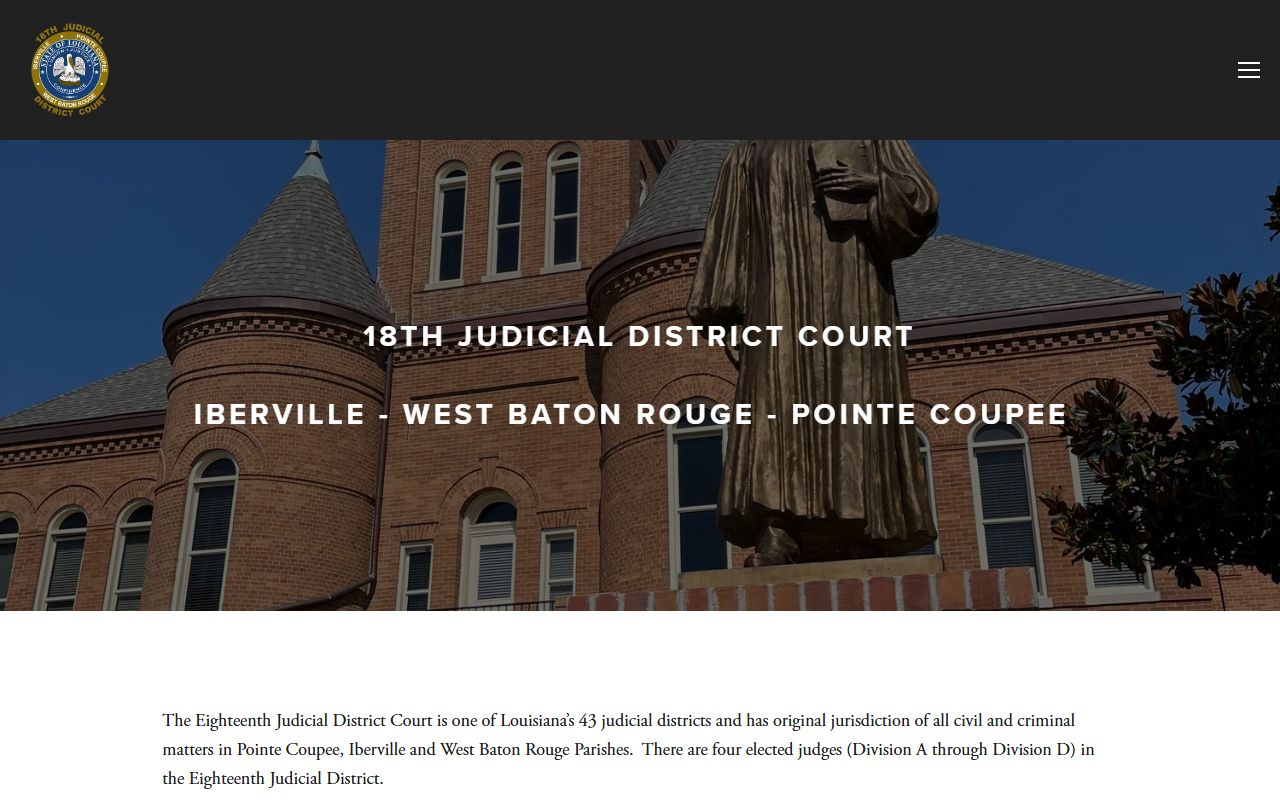
The court source matters because jail booking data and formal criminal case records are maintained by different offices after an arrest.
Jail records and court records answer different questions. The roster can show custody, arrest date, held-for agency, booking charge text, warrant text, bond amount, and judge information. The court record shows the charges that were filed, amended, dismissed, or resolved in court. For custody and booking details, use Iberville Parish jail inmate records. For booking-photo questions, use Iberville Parish jail mugshots. For formal case status, use the Clerk, 18th JDC, or courthouse record access.
Find Court Records After Arrest
The Iberville Clerk online imaging page says civil and criminal records are available remotely by browser, with daily, monthly, or yearly fees plus per-page cost. It states that criminal indices are available from 2000 and criminal images from 2014 to present. It also warns that online records are not official and that the official public records in the Clerk's office are the official version. The related Cott eSearch portal requires login, browser support, cookies, and JavaScript.
- Confirm the booking or arrest date through the jail roster or jail line when current custody is still an issue.
- Search the Clerk's online record portal by defendant name or case number if access is available.
- Use the Clerk counter when the online subscription gate, date range, or unofficial-record warning limits remote access.
- Compare booking-charge text with formal charges filed by the District Attorney.
- Verify bond, disposition, dismissal, or expungement information with the Clerk or issuing court.
The 18th Judicial District Court serves Iberville, West Baton Rouge, and Pointe Coupee and has original jurisdiction over civil and criminal matters. The Iberville Clerk of Court is at 58050 Meriam Street, 1st Floor, P.O. Box 423, Plaquemine, LA 70765-0423, phone (225) 687-5160. The 18th JDA Iberville office is in the courthouse on the 3rd floor and can be reached at (225) 687-5210.
Iberville Parish Charging Documents
After a jail arrest, a charge can change before it becomes the court record a defendant must answer. Law enforcement may book a person on suspected offenses or warrants. The District Attorney then reviews the facts and decides whether to file formal charges. In Louisiana practice, formal charges may proceed by a prosecutor-filed bill of information or, for some serious cases, by indictment. The court record is the place to confirm what was filed.
| Complaint or Arrest Basis | Bill of Information | Indictment | |
|---|---|---|---|
| Common source | Officer, warrant, or arrest paperwork | District Attorney | Grand jury |
| Role | Starts booking or warrant custody | States formal prosecution charges | States grand-jury charges |
| Where to verify | Jail roster or arrest record | Clerk criminal case file | Clerk criminal case file |
Iberville Parish Charge Status
Charge status can change after arrest. A roster row may show the charge that supported booking, while the court record may later show a formal charge, amended charge, dismissal, plea, trial result, or expungement order. That is why a jail roster result is not enough to decide whether a person was convicted. The Clerk's record, not the roster, should be used for the case outcome.
| Status | What It Means |
|---|---|
| Pending | The charge or case remains open and has not reached a final disposition. |
| Amended or reduced | The prosecutor or court changed the charge from the initial filed version. |
| Dismissed | The court record shows the charge was ended without conviction on that charge. |
| Nolle prosequi | The prosecution declined to proceed on that charge, subject to Louisiana procedure. |
| Convicted or pled | The case ended in a verdict or plea resulting in conviction. |
Bond After Iberville Parish Arrest
The sheriff's departments page says the jail handles bonding requirements. The roster's hold-reason text can show bond amount and judge information, including bond descriptions and judge-set bond language. A visible bond amount should still be confirmed before payment because one case can have more than one hold. Probation or parole holds, DOC holds, warrants, ICE, U.S. Marshals, or another agency hold may block release even when one charge has a bond amount.
| Bond Type | How It Works |
|---|---|
| Cash bond | Money is paid directly if accepted under the current order and jail procedure. |
| Commercial surety bond | A licensed bondsman posts bond under Louisiana rules and fee arrangements. |
| Property or security bond | Property or other security may be used when allowed by the court. |
| Recognizance release | The court releases the person on a promise to appear, if ordered. |
| No-bond or hold | A warrant, detainer, or court order prevents ordinary release. |
Call Iberville Parish Jail at (225) 687-3553 before traveling to post bond. Ask for the person's full name, arrest date, bond amount per charge or hold, whether a bondsman may post, whether cash or another payment type is accepted, and whether any hold blocks release. No official online bond-payment page, bond fee schedule, accepted-payment list, or bond counter hours were located.
Warrants and Court Arrest Records
No standalone public Iberville warrant search page was located on the sheriff site. Warrants can appear in current-inmate roster detail when a warrant is one reason the person is held. The roster format can identify a warrant, the issuing place, the statute or charge description, arrest date, bond amount, and judge. The sheriff contact directory lists Warrants, Carly Daigle, at (225) 687-5120.
Outstanding warrants should be handled carefully. A person trying to clear a warrant should contact counsel or the issuing court before walking in. Lower-court or bench-warrant information may be held by the issuing court or by the Clerk. A roster row can also show outside agencies, which means not every warrant or hold began with the Iberville Parish Sheriff's Office.
Charges vs Convictions
An arrest and a charge are not the same as a conviction. The sheriff roster even displays a presumption-of-innocence notice. A charge is an accusation or formal filing. A conviction is an outcome after a plea or verdict. Iberville Parish court records after a jail arrest should be read with that distinction in mind, especially when a booking charge later changes in the Clerk's file.
| Charge | Conviction | |
|---|---|---|
| Stage | Accusation, warrant basis, or formal filed count | Final plea or verdict on a count |
| Where seen | Roster, warrant, District Attorney filing, or Clerk record | Clerk criminal case disposition |
| Meaning | Does not prove guilt | Shows a resolved finding or plea |
Sealed and Expunged Records
The Clerk's criminal records page lists expungement fees: $200 to the Clerk, $250 to Louisiana State Police, $50 to the District Attorney, and $50 to the Iberville Parish Sheriff's Office, with money order or cashier's check only. DWI adds $50 to DPS&C. It also lists a criminal search fee of $20 per name. Louisiana State Police says expungement orders remove qualifying arrest or conviction records from access except as stated in La. C.Cr.P. art. 973.
| Sealed or Restricted | Expunged | |
|---|---|---|
| Public access | Limited by court order, juvenile rules, pending matters, or statutory exception | Removed from public access for qualifying records, subject to legal exceptions |
| Office to check | Clerk or issuing court | Clerk, State Police, DA, and Sheriff's Office fee route listed by the Clerk |
| Useful proof | Court order or case disposition | Expungement order and related disposition papers |
Restricted Court Records After Arrest
Some records may be unavailable or limited even when other case data is public. Juvenile matters, sealed charges, expunged records, certain dismissed matters, ongoing investigations, victim information, and confidential state-prison records can all have access limits. DOC states that records of people in prison in DPS&C custody are confidential under La. R.S. 15:574.12, although some custody information may still be available through VINELink or other agencies.
Important: Consumer decisions require FCRA-compliant sources, not casual roster or court-record lookups.